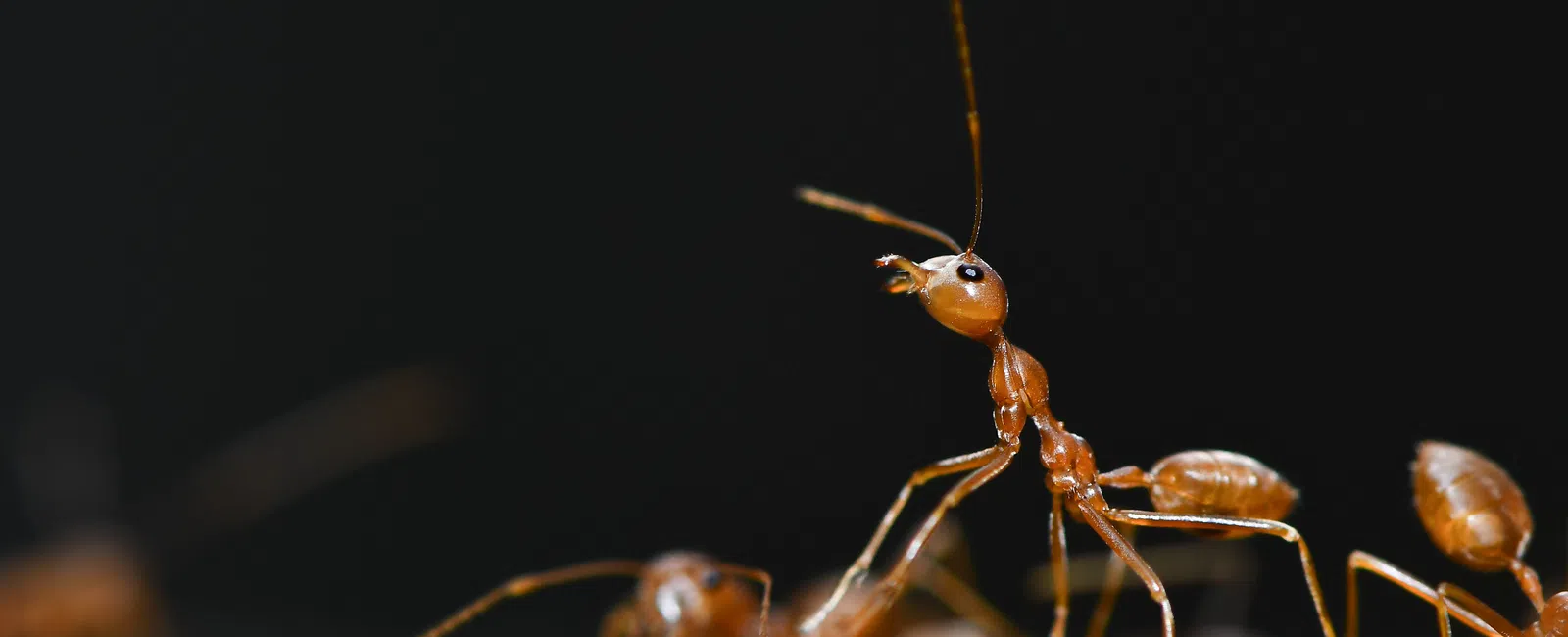
You mow the lawn on Saturday, it rains Sunday night, and by Monday morning there are three fresh dirt mounds in the yard that weren't there before. Give one a nudge with your shoe and the ground seems to boil. If fire ants have claimed your Southern yard, you already know they don't give up easily. Here's what's really going on down there, and how to get the upper hand.
At RIDD Pest Control, fire ants are one of the most common warm-weather calls we get across the Southeast, so let's answer the questions homeowners ask us most.
Why Do Fire Ant Mounds Appear After Rain?
It can feel like the rain conjures them out of nowhere, but the ants were there all along. Fire ants build their colonies underground, and a heavy rain does two things at once. It saturates the soil, which pushes the ants up toward the surface to escape the flooding, and it softens the ground so they can rebuild and expand in a hurry. What you're seeing isn't new ants. It's an existing colony throwing up a fresh mound where the digging just got easy.
That's also why flattening a mound does so little. The colony, and the queen who keeps it running, sits safe below, ready to rebuild by morning.
Why Are Fire Ant Stings So Bad?
Fire ants earned the name. Unlike ants that simply bite, a fire ant grips your skin with its jaws and then swings its body to sting again and again in a little circle. That's why a single ant can leave a cluster of welts, and why brushing against a mound can mean dozens of stings in seconds.
Each sting burns right away, and a day or two later it usually turns into a raised white pustule, which is the fire ant's calling card. For most people it's painful, itchy, and nothing worse. For anyone with a sting allergy, though, fire ants are a real risk, so a severe reaction is a reason to seek medical help quickly.
Do the DIY Tricks Actually Work?
Most of them, not really, and a few are worse than the ants. You'll hear plenty of advice: pour boiling water on the mound, drench it in gasoline, dump grits on it, hit it with club soda. Here's the honest rundown:
- Boiling water kills some ants but rarely reaches the queen deep in the colony, and it will scald you or your lawn on the way.
- Gasoline and other fuels are dangerous, illegal to use this way, and terrible for your soil and groundwater, so skip them entirely.
- Grits and club soda are harmless and also useless, since the old idea that ants eat grits and burst simply isn't true.
The theme is the same across all of them. If a treatment doesn't reach the queen, the colony survives and rebuilds, and a disturbed colony will sometimes split and move, leaving you with more mounds than you started with.
So What Actually Gets Rid of Fire Ants?
The reliable approach goes after the colony, not just the mound you can see. In practice, that usually means a combination:
- Slow-acting baits that worker ants carry back and feed to the queen, which is what actually brings a colony down.
- Targeted treatment of individual mounds to knock back the ants you can see while the bait does its work below.
- Regular, yard-wide attention, since fire ants are persistent in the South and new colonies drift in from neighboring yards and fields.
This two-step method, baiting first and then treating mounds, is what university extension programs across the Southeast recommend. It's also worth being realistic: on a Southern property, the goal is steady control that keeps your yard safe and usable, not a single treatment that ends fire ants forever. Anyone promising that last part is overpromising.
Ready to Take Your Yard Back?
Fire ants are stubborn, but you don't have to hand over your backyard. The RIDD team knows how these colonies behave in Southern soil, and we treat for the queen, not just the mound, so the results hold up through the season. Book online in minutes or call 833.378.0537, and let's get RIDD of the fire ants for you.